Hanoi and Halong Bay

The hotel room in Hanoi is small but nice, though the deluxe city view is mostly a view of someone’s messy rooftop. There’s a laneway below with lots of activity: motor cycles coming and going, women chatting and opening and closing intriguing shops. The hotel food isn’t as good as in Hoi An or Da Nang and the pastry the Vietnamese are supposed to make according to French chefs’ recipes, is not as good as the danishes I ate in Germany. But I eat it anyway because I have a private guide and a driver and Hanoi is packed with things to do.
We start at the government complex. On the way Viktor Orban’s ride came by and I suggested we kill the fascist. Hyu, my guide looked at me with concern, till I explained about my mother being Hungarian and my family being Jewish, and anyway I was only joking. We saw a square as big as Tiananmen in Beijing (at least according to Hyu, having seen Tiananmen I wasn’t convinced, I remember it went on forever). Then we saw Ho Chi Minh’s house on stilts (no kitchen or bathroom) and a pond full of giant carp. The mausoleum was closed so I went without.
We went on to the Museum of Ethnology and walked around, and inside, different types of houses, built by different tribal groups. Some were warm weather houses made of straw or bamboo with big windows and balconies and stairs made of poles with protruding platforms. They had central areas and private rooms and I wondered what it would be like to live in them. Sometimes it felt like a laborious climb inside and I wondered how people would run up and down these stairs. I would have just stayed in the house all day.
There were cold weather houses built by tribes in the mountains to the North West, or the Central Highlands, with clay walls and thick roofs and anterooms blocking the main room off from the entrance. I imagined fires and warm clothes. There was also a central museum with tribal artefacts and clothing, including an enormous totem pole.
Then there was lunch on a veranda and a walk through the Temple of Literature which was a university for training mandarins, boys of course because if they passed their exams they could become very powerful which is something unsuitable for women, possibly even would make them sterile. There were rows of plaques made of stone, each resting on a turtle. In 400 years only about 1000 or so had passed the final exam. I wonder if it might have improved the figure if they’d allowed girls. I wonder if it might have improved the government.
A short break and we were off on a cyclo tour of the old city. The old city of Hanoi isn’t a motorised traffic free zone like the one in Hoi An, so the most exciting part of the tour was sitting on a cyclo, basically an armchair with a bicycle attached to its backside, while thousands of mopeds and the occasional car rushed towards me, or backed in to me, and somehow missed. I was astounded and pleased with how they managed to miss. Easily the most exhilarating ride I’ve had since the Chinese tour group made me sit in the front seat of all the taxis we caught in Beijing (cowards!). In Beijing lots of cars (black ones mostly) kept missing each other (and me). I did see a few bicycles, but I noticed most of them were parked in huge numbers on street corners.
In Hanoi there was the odd bicycle and a fair few cars but the moped was king. There were droves of them, ridden by people talking on mobile phones or by women with an odd child squashed between them or by lots of young girls with Hello Kitty helmets and masks covering the lower half of their faces. I thought at first they might be worried about illness but I’m rapidly coming to the conclusion that the mask protects them from dirt, mud and fumes.
Next day I had a Tai Chi lesson with a master who was much better than me and then Hyu and I went for a walk in the markets mostly to taste the food, it was a Vietnamese cuisine walking tour and the food was much better. I was so stuffed I couldn’t eat any more. Also I need to buy another backpack because as usual I had packed without planning for the fact that I would buy things. Good to see that over the years, nothing’s changed.
We were looking at backpacks in a shop when I noticed the price in Vietnamese dong and made a quick calculation in my head. “About $9,” Hyu said, trying to be helpful.
“If someone told you the price in $US would you find that helpful,” I asked.
“No of course not, but I’m not American.”
“Well neither am I,” I said.
He agreed that was true. He was wise enough not to talk about $US after that but I can’t guarantee what he’ll do with the next Australian tourist. Most of them probably grin and bear it but I found it confusing. Our dollar is worth less that the American one, so I kept thinking I was getting bargains.
The next day we left for Halong Bay. On the drive through Hanoi I noticed long narrow houses with peaked roofs and decorated balconies. They were called tube houses, narrow because the owners were taxed for the width of the street frontage. They looked like rows of ladies with parasols, arms linked, waiting by the side of the road.
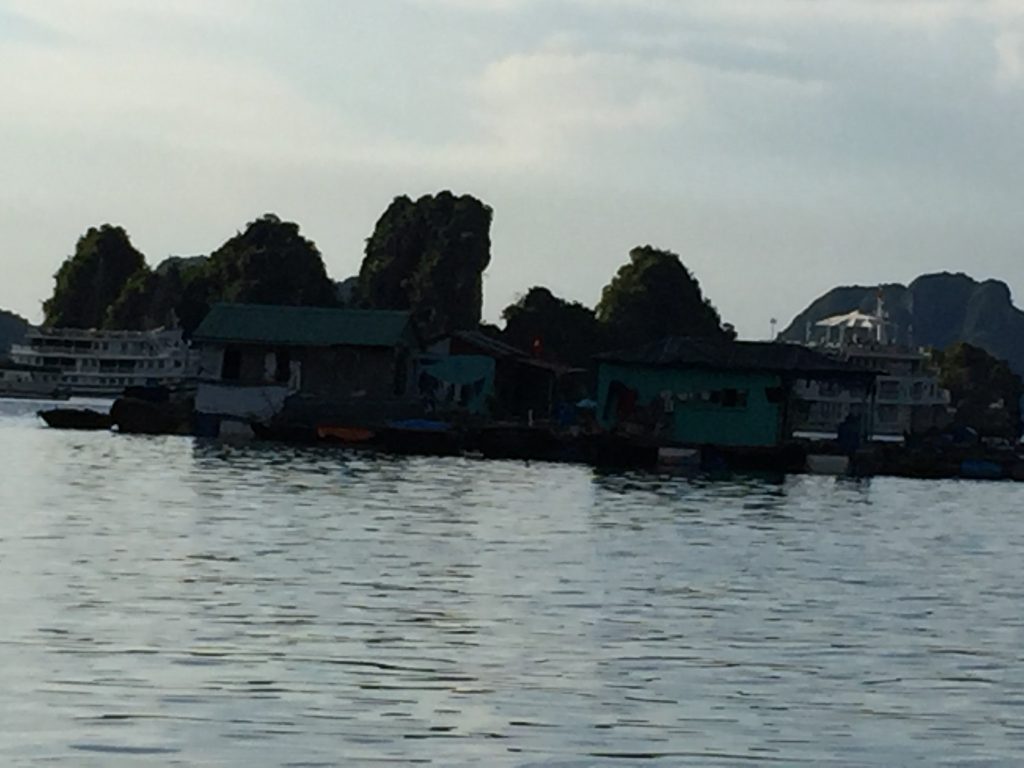
As we got out of the city there were jagged mountains behind the houses, like rows and rows of teeth. The same were growing out of the water at Halong Bay. It’s believed that a dragon sent her children to protect Vietnam but I think it more likely she sent her dentures. It was strange waking up after a night’s sleep in the boat to see row after row of rocky teeth passing by. We saw archaeological digs, tiny churches and a town on pontoons complete with floating grocery store that came to you. What must it have been like to grow up there?