Northern India

When I told people I was going to India I met with a variety of comments. My Indian friends encouraged me, my yoga friends were excited for me and some people said: ‘Buy locks’ (always good advice) and ‘Trust no one’ (as if I was going to the X-Files).
I do remember thinking: ‘Indians probably do things differently’ but didn’t realise how differently until I got to Sydney airport at 6am and Singapore Airlines wouldn’t let me on the plane. When I presented the Indian visa, it turns out I was presenting the email telling me I had a visa and there was actually a link at the end of the email I should have clicked. My visa was there and I didn’t have a printout. As if anyone reads that far! After 45 minutes of sheer freak out and a $10 gift (it was definitely overpriced) to Flight Centre, I re-presented the correct page to Singapore Airlines and was allowed on the plane.
I sat on a plane for eight hours and another one for about six more and, with time zone changing, a whole day passed and I prepared to exit at Delhi airport at 9pm, a little nervous as to what I’d encounter. I locked up the various pockets in my backpack, kept an eye on everything, watched carefully for my bag on the baggage carousel and worried that my ride wouldn’t arrive. I had a folder full of emergency numbers.
I breathed a sigh of relief when I emerged from customs to find someone waiting with a sign from the tour group. His name was Ravi. He grabbed some of my baggage and sauntered out of the airport towards my ride. I raced to keep up. Eventually I asked him if we were walking to the hotel. He good-naturedly slowed down. Then he put me in an air-conditioned car and said he would see me in the morning.
One of the first things I noticed as we drove through Delhi was that the lanes marked on the road were purely fictional, deriving existence only by being ignored. Several times, our car felt like a Harry Potter bus as it squeezed between vehicles and somehow wasn’t squashed. Fortunately, it was night-time, I was tired and I confess I was really more amused than alarmed. I’m not sure what that says about me, but I have faced worse traffic.
The tour didn’t begin till the next day so Ravi hired a driver to take me round New Delhi. We saw monuments and religious places: Sikh, Muslim, Hindu. I was confused about being in another country and kept looking around so I didn’t see much that tourists are supposed to see. I wandered around a temple or two and it was so stinking hot after a while I refused to leave the air conditioning till it got cooler. We drove around for a while.
We went to Gandhi’s tomb when it got cooler. He’s a hero in India though I’m not sure why. He was skinny as a rake; most Indians definitely aren’t. India apparently leads the world in Type 2 diabetes. He advocated opposition by non-violent means, not the case in India today if you consider the atom bomb, Kashmir and the enmity with Pakistan. And the riots in Gujarat where Muslims were killed. Or even the arguments on the side of the roads. He avoided technology but many Indians now make a living being computer programmers to the rest of the world. I met many people who said they were hoping to get a job in Australia. You and me both was my usual answer. They looked rather confused when I said that.
Gandhi seems to be the symbol of Indian independence though I doubt he was the only one who made that happen. Perhaps Nehru and others simply became tarnished by continuing to live when Gandhi was assassinated. Or perhaps, as Ravi, tells me, Indians value religion more than anything else. Being skinny and assassinated speaks to them.
The next day we set out for Agra and the Taj Mahal. The roads weren’t as bad as expected, I don’t think my heart was in my mouth more than once or twice but then I’m not I’m not very excitable. There were cows to contend with, and also pigs, dogs, tuk-tuks, motorcycles, trucks, buses and occasional cars to avoid. The main road rule seemed to be ‘first in, best dressed’. Indian drivers’ skill at avoiding each other was breathtaking. ‘Blow Horn’ was written on the back of every car in big friendly letters with flowers and assorted illustrations, a reminder as you appeared from behind a larger vehicle to tell everyone you were there. I did get a page of some road rules, here are a few:
Article I: the assumption of immortality is required of all road users
Article II: Indian traffic, like Indian society is structured on a strict case system. The following precedence must be accorded at all times. In descending order, give way to cows, elephants, camels, buffalo, pigs, goats, dogs, heavy trucks, buses, official cars, pedal rickshaws, private cars, motorcycles, scooters, tuk-tuks, handcarts and pedestrians.
Article III: all wheeled vehicles will be driven in accordance with the maxim: to slow is to falter, to brake is to fail, to stop is defeat.
Article IV: Overtaking is mandatory. Every moving vehicle is required to overtake every other moving vehicle, irrespective of whether it has just overtaken you. Overtaking should only be undertaken in suitable conditions, such as in the face of oncoming traffic, on blind bends, at junctions and in the middle of villages and city centres. No more than two inches should be allowed between your vehicle and the one you are passing – one inch in the case of bicycles or pedestrians.
Article V: the tenth incarnation of God (who will destroy the universe) will be an articulated tanker.
Despite the assorted wildlife, including the drivers we managed to get to Agra. We signed into the hotel and went to the Taj Mahal. It looked just like all the photos, even the cartoonish line drawing on my parents’ business card, except there were lots of baboons. Climbing all over the balustrades and showing their backsides to all the tourists. Who were taking photos. The Taj Mahal itself was beautiful on the outside but boring on the inside. There were buildings on both sides which don’t make it into the tourist brochures but that’s probably because they can’t get the baboons off.
There were lots of other forts, the Agra fort made of deep red sandstone with a white marble insert were the emperor, who built the Taj Mahal lived, Fatehpur Sikri where a guy dived into a pool thinking he would get money from the tourists but we all ignored him. The stairs were different sizes and turned lots of corners so potential invading armies would be exhausted when they got to the top. A hotel lobby full of pictures of old Indian guys in British uniforms, straight-backed tapestried couches and stuffed animal heads that was a Maharajah’s castle, which had been made into a hotel to make ends meet. The Maharajah still lives there but he didn’t make an appearance as we sat in the courtyard drinking our gin and tonics. It was a working farm too and had a garage full of Rolls Royces and old farm implements. Ravi called it a Marigold hotel.
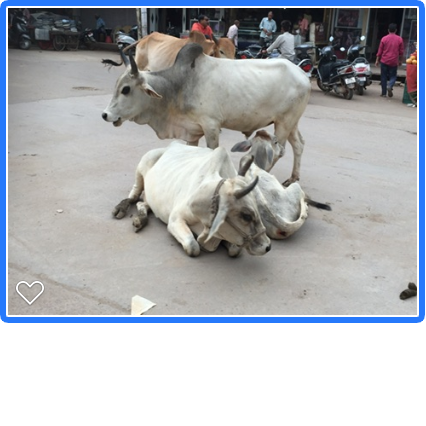
There were cows everywhere we went especially in Rajasthan. The cows wander the roads, confident that no cars will hurt them. The cars go around them. They will stop for cows but not for people. The cows sashay across the road in front of you without fear, congregate at intersections, raid garbage bins and lined up along the middle of the road. They especially like the middle of the road; the cars keep the flies away and the petrol fumes are apparently intoxicating. I guess it’s boring standing around doing nothing, might as well get stoned. What are they going to do when a climate conscious India gets electric cars.
They also eat garbage out of the bins, plastic wrappers and leftover plastic European food. Cows can wonder freely and someone even brings truckloads of grass to feed them each day but it’s not enough. So, as well as being stoned, the cows are malnourished. Probably they’d rather be run over, at least they’d die quickly. That might be why they sashay out in front of the cars. But Hindus worship cows, they would be consumed with guilt if they hit one. So they die slowly.
At Bundi, I gave up and sat out the castle tour. I’d already seen a snake charmer with a cobra I refused to approach till he closed the basket and been feted by the locals for being a tourist on Tourist day. We had our photos taken after they’d tied turbans on our heads and garlanded us with dead marigolds. The school children lined up to have selfies taken with any European they could find. All over India, they liked having their photo taken with Europeans though I think we’re a rather boring lot myself. What we are is definitely not Indian.
By the time we were set to tour the castle I’d had enough and sat down below with peace and quiet. An old woman came and sat nearby for a little while and there were more baboons. They made all the noise in the area, otherwise it was quiet. Ravi came and sat with me for a while and I met two young people on a motorbike who were studying at university. Ravi translated for me. They had to study hard, he said, because competition was fierce. In a country of 1.3 billion people not everyone could graduate.
In Bundi, we stayed by the river in large tents done up as hotel rooms with elephants on the walls in compromising positions. In Udaipur we had to walk to our hotel because it was so high up the bus couldn’t make it all the way up. We went touring in tuk-tuks then walked all over town. It was all made of stone and there were lots of shopping opportunities. There were shopping opportunities everywhere, in Agra they showed us how carpets were made and then proceeded to lay them out so we could buy them, in Udaipur we bought handmade clothing Indian women sowed all night so they’d be ready for the Europeans to try on the next day. In Jodphur, there was a weaving demonstration and sale and then a pottery demonstration and sale. The pottery demonstration fascinating, a man made a large stone revolve with a stick and made three pots with lids. I bought something at that stop, I’d long been conserving my money when I began to realise that what seemed cheap was eating into my bank account.
The worst encounter I had was at Jaipur. We saw the pink palace and went walking through the market and then we went to the jewellery store which I’d been saving my money for. I love jewellery. We’d talked to a palmist in Udaipur who told me to buy an emerald though he downgraded that to a green stone when I told him an emerald might be expensive. Nevertheless I priced an emerald at the jewellery store out of curiosity.
The salesman showed me a tiny little emerald set in a very thin platinum setting. The ring would probably fit a 12-year old’s finger or perhaps an anorexic 16-year old. He wanted $700. “How much to resize it for my finger?” I asked. He wanted $400 more. That’s $1100.” I said. “Yes, but it would cost three times more in your country,” he said wisely.
“No it wouldn’t,” I said. His wise look changed to shock. “Why would they price something so high no one would buy it?” I said. I said I would look at the green amethyst. “But it’s barely green,” he said. “The emerald is Mercury’s stone, that’s probably what the palmist meant.” I bought green amethyst and chose a bezel set stone because the setting is usually stronger, It fell out anyway.
I made several attempts to see tigers, and actually saw two, both at the Kolkata museum. There was also a third tiger, painted on the wall at the temple in Udaipur.
In Ranthambore, in Rajasthan, I went on three safaris, bumping on dirt roads and rock. We saw one leopard on the second day, way up on the hill as we were making our way into the game park. It was so high up, it was hard to tell it was a leopard until it moved its head to look at us. My pictures are very grainy though others brought better cameras.
We didn’t see any tigers though the men tried, waiting silently in areas where a tiger had been seen recently or was known to wander round. Someone spotted a tiger in one area so everyone drove frantically. There was a line of jeeps full of tourists but the first one hogged the viewing space where the guide gave a long lecture. By the time he’d finished the tiger had taken her bath and gone back to her cave. The other jeeps escaped but we got caught in the rain. The driver and the guide jumped out and spread tarpaulins over the jeep. I was lucky, I was fully covered, but those behind me got wet. I could see out by looking behind where the tarpaulin gave out but it was mostly boring. Tigers apparently, are the only cats who swim but even they know to stay out of the rain.
We did see lots of birds, especially peacocks and a little brown and orange number which perched on our jeeps when we stopped at the toilet blocks. There were spotted deer, antelopes, owls and monkeys galore and cheeky, but clearly not many tigers or there wouldn’t be so many other animals. The monkeys threw things at me, I had the hide to climb out the jeep right under his tree.
Finally there was Kolkata. I’d been warned Kolkata was boring and it was except for the rain. It flooded everywhere though the cars kept going, even in a foot of water. I didn’t though, I fell in the water and got my shoes and clothes wet. Nobody seemed to notice. There were people everywhere trying to find shelter.
Kolkata is like a commercial version of Melbourne, full of stately buildings and trams but also colourful billboards above the shops on every shopping street. We crossed the Hoogly River and drove around the large railway station at Howrah, the city across the river. There was colour and people walking and people carrying things and lots of movement. I think that was where the boy who became Dev Patel was lost in the movie Lion and had to sleep on cardboard. I kept taking photos.
I went to Kolkata during Durga Puja. To celebrate the goddess Durga (Parvati), the mother goddess in her fierce aspect (she often has a lion), various community groups build booths around the city for worship. The goddess is pictured with her husband, Shiva (I think he’s the blue guy) and her sons, Kartikeya and Ganesha, as well as the aforementioned lion. Ganesha is the elephant-headed god seen at the entrance to most buildings. Story is that Shiva got really annoyed one day and cut off his head, then had to find him another head quick smart so he took the first head he could find. I’ve always rather liked Ganesha, he seems happy enough even with an elephant’s head. A lesson I think we all could learn from life.
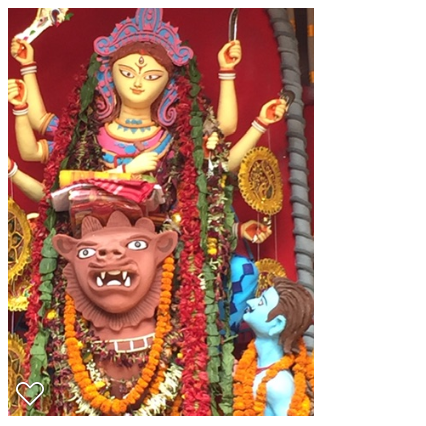
So, these displays of Durga are all over Kolkata and the various groups seem to put a lot of effort into them. The dolls look like store dummies and the whole thing seems kind of amateurish but amazing all the same for the effort involved. They don’t just do displays of the goddess, there were booths made of metal pots and booths with light shows on the walls and ceiling, even a booth with a computer theme including circuit boards and another one made of hub caps. The ingenuity and creativity was astounding.
So, what do they do with all these? After five days they carry them in carts through the city and then throw them in the river. So much work and it all goes in the river. It’s quite a ceremony with boys dragging them down to the river, then jumping it to make sure they sink. It’s quite festive too, there were shops selling food. Wikipedia says they are all made of biodegradable material so there is minimal environmental impact but it all looks like plastic to me. I can’t believe that they dispose of all that work, I’m sure someone comes back at night and fishes the dolls out for next year.
And then I got on a plane and went to Chennai, via Delhi, to see southern India. On the way I spoke to a guy who works in IT and wants a job in Australia.
