Visiting the Past

All my friends had cousins when I was a kid. They had aunts and uncles and got lots of presents at Christmas time. They often lived in strange places my friends went away too while I had to stay at home and play with my sister. I did have some cousins in Canada, which, strangely enough, no one else had, but they were too far away to play with. And they didn’t really send presents, only clothes they didn’t use anymore.
Another aunt came from Hungary when I was little but she settled in Brisbane and had my cousins there. We used to go and visit them at Christmas. We would get out of bed when it was still dark and creep along with other cars up the Pacific Highway, crossing the rivers in ferries. Usually there were two cars, my father and my grandfather wouldn’t let the other drive, and the rest of us fitted in wherever they thought convenient. I remember the early morning fog, and how confident my grandfather was, and how cold I was.
We used to play at travelling to Canada in my grandmother’s lounge room. We would board the plane near the door to the kitchen and because planes couldn’t travel very far back then, we would have to land to refuel at the armchair we called Fiji. We had a short break to wander round the table in Honolulu and landed in Montreal at the gas heater. There my aunt was waiting for us with her two daughters. I didn’t know what they looked like, maybe like my grandmother who’d be waiting to hug us.
I loved the red box in my grandmother’s desk. She kept it in the second drawer and in it were all the things that were important to her. There was a list of tongue twisters she’d practiced, learning English, and another list of American states with the capitals, which she had memorised. She bought me a puzzle once with all the states so I memorised them too. To this day I can recall more American states than most Americans.
The most important things in the box were the things she received from her granddaughters. As I grew older the box was filled with report cards and articles about my achievements in school but when I first looked in the box, it held mostly letters from my older cousin in Canada. Apart from all the things she did at school, my cousin used to write poetry. It rhymed, like poetry did back then, and I’m sure most poets would sneer at them, but I loved her poems. I would read them over and over again. It said something about what I might be if I only wrote poetry, which I didn’t. I couldn’t wait to meet my cousin.

I loved the stories my grandmother told me about Hungary. How the city was so beautiful with bridges across the river and buildings nestled up the hills on the Buda side as you looked across from Pest. Meeting friends for coffee. How her childhood bedroom was lined with books and how she wanted to be a surgeon but couldn’t. There was a numerus clausus at the universities then, the number of Jews, was limited, mostly to those who studied law. A woman couldn’t study medicine. Even my grandfather had to go to Brun, in the Czech Republic, before he could study engineering.
My grandmother went to Spain after high school, which was after the First World War. Her family dragged her back five weeks later because apparently, she fell in love with a much older man. He mustn’t have been the right older man because she told me her family insisted she marry her first husband, who was also a rich older man. There was no money left after Hungary lost the war and my patriotic great-grandfather lost everything he had invested in Hungarian war bonds. Then he died, apparently of syphilis. Her mother couldn’t have sex, my grandmother told me, so he had girlfriends. The family needed something to take their mind of all that.
It could also be that my grandmother fell in love with her first husband, she had a thing for older men, but she fell out of love as time went on, and he spent all his money partying. He was the father of my aunt, which is why she went to Canada. She felt let down by my grandmother and hated my grandfather, who was my mother’s father.

The stories that held me the most were the stories about the second world war when their neighbours denounced my family to the Nazis. They were marched away to concentration camp in Austria. My mother was twelve years old. My grandmother pushed her from the line and she walked on her own back to Budapest, where my grandfather had arranged for her a false identity, and a place in a convent school. My aunt kept marching, no one had made arrangements for her. She must have felt neglected, forgotten, though unlike my mother she was of an age to survive concentration camp. She wouldn’t have known that at the time, must have wondered what would happen to her, must have thought the others were safe while she was facing the Nazis alone.
In the convent school there were two other Jewish girls with false papers. According to the story my grandmother told me, the Nazis came one day and checked everyone’s papers. The two other girls were dark-haired, with features considered typically Jewish and the Nazis shot them as soon as they realised the papers were wrong. Right there in front of the other children. But when they came to my blonde, green-eyed mother they weren’t so sure, so they let her live. I wonder what she must have felt, or if she was numb, if she didn’t know how to react to the whole affair.
I went to Europe in my twenties with both Vienna and Budapest on my list of cities to see. Vienna used to be the centre of Europe, at least it felt like it to me, considering the stories I grew up with. By the time I got there, it was conservative, a city near the Iron Curtain that had known better days. The capital of the Austro-Hungarian empire once, before my mother was born. I got there early and couldn’t afford cafes, so I had a picnic in the park, on the grass. The Viennese, rugged up in their coats and hats, though I didn’t think it was that cold, frowned at me as they circulated on the paths. No one said a word, so I didn’t understand why till I saw the sign that said ‘Keep of the grass’ in three languages. They probably thought I was crass. Though it had many beautiful buildings, I didn’t like Vienna.
My mother was disappointed too. “It’s not how I remember it,” she said. “It used to be more vibrant, full of culture.” Now it was full of Russian immigrants who grabbed my arms at street corners, asking me to put in a good word for them somewhere. I’m not sure what they expected. Their German wasn’t clear and mine isn’t that good.
From Vienna, it took an hour to reach the Hungarian border and four hours to cross it. We spent the time in a large room. It felt like an airport waiting room with windows where you handed over documents along one wall and then sat on couches in the rest of the room, waiting for something to happen. A bit like Services NSW. No cafes, and we hadn’t brought any food. My mother expected there to be cafes everywhere. “Of course, there are no cafes,” my father said, “you can’t expect such things in a communist country.”

My mother and father had their visas from Sydney but I needed one. I had to state that my mother was born in Budapest and, even though they had cleared her weeks ago, they had to investigate again who this woman was and whether she was really my mother. When they finally let us go, the freeway was empty and flat. Grass everywhere there was road and big pylons marching parallel to the road, carrying electrical wires. We came to Mosonmagyarovar first. My grandmother was born there. There were rows of buildings on the main street made of large stone blocks with shops downstairs and apartments upstairs. Gated side streets where balconies looked out on courtyards and laneways. More European than Budapest, which was influenced by the Turks, this was the Burgenland, where the Austrians had built castles to keep the Turks out.

The house where my family lived was free-standing and enormous. It had its own block with streets on all sides, quiet leafy streets. My great-great-grandfather was the local wine merchant. When the Communists took over the house was too big and was broken into flats. We found a man who opened the huge wooden doors and let us into a courtyard full of washing lines and trees. The flats all opened off the courtyard. My great-grandmother had three sisters and two brothers. Each of them was a story, some stayed in Moson, some went to Budapest, one ended up in Spain and another in Chile. One uncle was awarded the Legionne d’Honeur in France.

My grandmother had two sisters and they lived in a large flat in Buda. Her mother came back to Moson for the birth of her first child. Long before the Nazis came, there were lots of tales of the doings of my family in Moson, fancy-dress parties and family picnics. Lots of pictures too, till the Germans rounded them up and shipped them off to Auschwitz where all my cousins ended. Only those who’d gone to Budapest survived, some of them, anyway. And the ones in South America.
Budapest is 161 kilometres away. We enter it through Buda, on the northern side of the Danube and cross one of the many bridges to the Pest side. Buda is hilly

but Pest is flat and full of tall buildings, built in the eighteenth and nineteenth centuries. The Danube snakes right through the middle with the Houses of Parliament on one side and the business district on the other. I don’t know which bridge we crossed; they’re all quite famous. “I feel like a foreigner,” my mother said. “Even the names of the streets have changed, I’m not sure I could find my way around.”
Budapest was decadent. It’s the best word. Full of beautiful buildings that were dark inside and, though the paintwork had faded, it hadn’t been renewed. Buildings were cracked. I went to Budapest another time, twenty years later with my uncle and cousin and the buildings hadn’t been repaired. They were still dark and still full of cracks. The Communist government had gone, and there were shopping malls everywhere, but no one had fixed the buildings.
In Pest, there is a large square called the Heroes Square. It has a number of columns and statues of people whom Hungarians thought important. Actually, the columns might have been the heroes, I don’t remember and I haven’t got a photo. They stood up straight and the square was large. Behind it was a large park with a lake and an old castle. “I used to go swimming here,” my mother said, “and there was an ice-skating rink.” I remembered the ice-skating rink, that was where all the boys had been admiring my aunt and had carried home her ice-skates. Much to her disgust, my grandfather (who was her stepfather) had sent them all away. She remembered it clearly, and with anger, till I suggested that he was just protecting her from teenage boys with one thing on their minds, and she admitted, I might be right. The hate was strong, though, I think she just put it aside for a few minutes.
“This is where I came the night after they marched us away to the border,” my mother said. “I had to wait overnight till I could go and get the false papers my father had arranged for me.”
“And…,” I said.
“I’ll tell you,” she said. “Let’s look around first.”
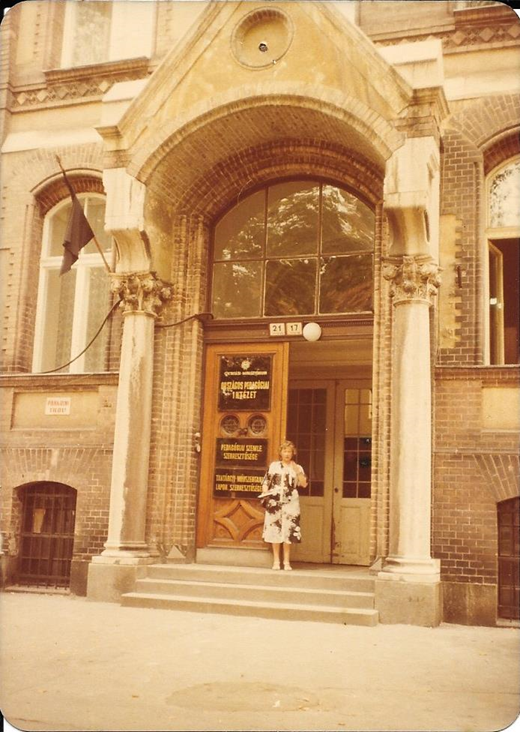
We took the third street on the right. “I went to school there,” my mother said. The building was still a school, though no longer a Jewish one. She stood in the doorway, while we took a photo.
“Here’s where I used to live.”
We walked through a tunnel, into a courtyard. The house was badly kept, its ornate decorations had been broken and not restored. There were large cracks, new pipes had been laid in, on top of the walls. The house reminded me of a motel in regional NSW, rows of doors opening on to verandas, three floors of them.
“This courtyard seems so small,” my mother said. “I remember it as much bigger.”
“You were smaller then,” my father said.
My mother looked around, confused, trying to see where she’d played. She pointed to some stairs on the right-hand side. “This was the kitchen window. Those three windows on the front of the house were ours. In those days the front flats, the ones that faced the street, were the more expensive ones.”
We knocked on a door on the other side of the entrance tunnel. “This was where the lady lived who wouldn’t let me in,” she said. “After I escaped from the Germans and came back to Budapest, I had to find a place to spend the night. I knocked on this door to ask the lady if she would let me spend the night with her. She didn’t answer the door. I think she was scared of the Nazis. I spent the night in the park.”
“You must have been scared.”
“Everything was scary. There was no point in being scared.”
The same lady, now in her late seventies, let us in. She was still quite alert, though confined to a bed. She remembered my mother and said she was happy to see her again. She didn’t mention the night my mother knocked on her door or any of the things that had happened to send my mother away. For half an hour she entertained us with the latest gossip of the neighbourhood, who had gone where and done what, till her daughter asked us to leave so she could rest.
We wandered round Pest after that. We saw a paternoster, one of the remaining few old-style lifts which was really a series of little wooden rooms behind open doors, tied together by chain which went round and round. People stepped onto them and off again when they reached the floor they wanted. My mother had been afraid of them as a child, she thought when you reached the top you would come down on the other side, upside down. I went up with her and she clutched me as we

swung across to the other side and came down right side up after all. My father looked for congregations of people so he could point out how in communist countries, they had to line up for salami. He found three people lined up at a corner and pointed to them. One woman was holding a salami.
None of the shops had names, they were just “Baker no 1” or “Shoe Shop no 3”. Later, when the Communists left, they re-opened Gerbeaud, the famous coffee shop that everyone told me was like being in Paris. I went there with my uncle who lived in Brussels. He was in awe of the place. It was famous. For myself, I’ve seen better cafes in Double Bay, mostly owned by Hungarians.
We took a boat on the Danube to the Houses of Parliament and went up on the Buda side to the Fisherman’s Bastion. It’s a wall of light-coloured brick with windowed turrets every few feet, for soldiers, to man the ramparts and pour boiling oil on the people below in the Middle Ages. At least that’s what I kept thinking. The nearby Matyas Templom was a church, probably a cathedral, though it didn’t look like anything in Western Europe. It had a pattern of different coloured bricks on the roof, like a mosaic. It was well-looked after and I rather liked it. There was a Hilton Hotel there too, so we sat in the café.

“Over there, somewhere,” my mother pointed towards the river, which was small and far away, like a piece of ribbon I could touch and hold, if I just reached out. “Over there was the convent where I was hidden during the war. It was destroyed completely in the bombing. We ended up shivering in the bomb shelter till the Russian soldiers came. They liked children; they gave us chocolate.” I remember my grandmother telling me there were two other girls hiding there with my mother, but the Germans had shot them. They only spared my mother because of her blonde hair.
“I’m sorry, I can’t remember exactly where it was,” my mother said after a while. “Or anything much that happened. I’m trying to remember for you, but I can’t.”
So where did my grandmother hear the story?
